Amazon cutting thousands of jobs in latest AI push
Beth Galetti said Amazon needs to be organized more leanly, with fewer layers and more ownership
Add bookmarkListen to this content
Audio conversion provided by OpenAI

Amazon is planning to eliminate around 14,000 positions in its corporate division, the company revealed this week. Beth Galetti, SVP of people experience and technology at Amazon, pointed to artificial intelligence (AI) as one driver for the cuts.
She noted that AI is “enabling companies to innovate much faster than ever before,” while also recognizing that Amazon needs “to be organized more leanly, with fewer layers and more ownership.”
At the end of July, Amazon reported second quarter results which beat Wall Street expectations on several counts, including a 13 percent year-over-year increase in sales to US$167.7 billion.
Last week, Amazon debuted the Blue Jay robot to power AI and automation in its operations. The technology is designed to reduce repetitive tasks, improve safety, and boost productivity while speeding up delivery. Amazon also announced Project Eluna, an agentic AI model built to help operators make more informed decisions.
Join the PEX Network community

Don't miss any news, updates or insider tips from PEX Network by getting them delivered to your inbox. Sign up to our newsletter and join our community of experts.
Learn MoreAmazon is ‘strengthening culture and teams’
Last year, Amazon CEO Andy Jassy posted about strengthening the company’s culture and teams, explaining how Amazon aims to operate like the world’s largest startup, the importance of having the right structure to drive that level of speed and ownership, and the need to be set up to invent, collaborate, be connected, and deliver the absolute best for customers.
“Many of you have put significant effort into that work of strengthening your organizations by reducing layers, increasing ownership, and helping reduce bureaucracy,” wrote Galetti. “We’re already seeing the results, with teams moving faster and many Amazonians feeling more ownership, and the S-team and I appreciate all the work you’ve done.”
The latest reductions are a continuation of the work to get even stronger by further reducing bureaucracy, removing layers, and shifting resources to ensure Amazon is investing in its biggest bets and what matters most to customers’ current and future needs, she added.
Register for All Access: AI in PEX 2026!
AI is the “most transformative technology”
The current generation of AI is the “most transformative technology” seen since the internet, according to Galetti. “Some may ask why we’re reducing roles when the company is performing well. Across our businesses, we’re delivering great customer experiences every day, innovating at a rapid rate, and producing strong business results. What we need to remember is that the world is changing quickly.”
Amazon is working to support everyone whose role is impacted in the layoffs, including offering most employees 90 days to look for a new role internally and prioritizing internal candidates to help as many people as possible find new roles within Amazon, Galetti said.
“For our teammates who are unable to find a new role at Amazon or who choose not to look for one, we’ll offer them transition support including severance pay, outplacement services, health insurance benefits, and more.”
Earlier this month, Nestlé, the world’s largest packaged food company, revealed plans to eliminate 16,000 roles in the next two years as it targets huge cost savings supported by business transformation and process automation.
The Business Transformation World Summit's Failure Case Study Bundle
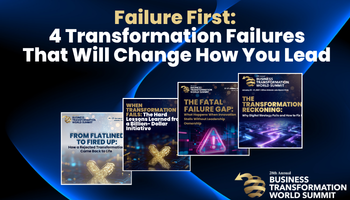
Transformation doesn't fail quietly. It fails in missed targets, stalled programs, frustrated teams, and strategies that looked perfect on paper but didn't survive reality – and yet, most leaders are still only hearing the success stories.
The Business Transformation World Summit's Failure Case Study Bundle brings together four candid, real-world transformation failures from experienced senior leaders who have been in the room, made the decisions, and seen what happens when things don't go to plan.
No polish. No hindsight bias. Just honest insight into what went wrong, and what they would do differently:
Download the bundle now and learn the valuable lessons most leaders only discover too late – and so you don't make the same mistakes they did.
Download Now