6 trends shaping process mining in 2026
Process mining is evolving into a true business differentiator, enhanced by emerging AI and autonomous technologies
Add bookmarkListen to this content
Audio conversion provided by OpenAI

Process mining is undergoing a revolution, shifting from ‘static reporting’ to ‘real-time intelligence’ (aka process intelligence).
This will continue into 2026 as process mining evolves into a true business differentiator, enhanced by emerging artificial intelligence (AI) and autonomous technologies.
In this regard, process mining is progressing into something more powerful, says Vinod Gojev, data-driven solutions and applied AI expert. “It’s still the fastest way to see how your business actually runs, not how your process owners ‘think’ it runs. That’s not just useful; it’s non-negotiable for any serious digital transformation effort.”
Join the PEX Network community

Don't miss any news, updates or insider tips from PEX Network by getting them delivered to your inbox. Sign up to our newsletter and join our community of experts.
Learn More6 trends that will shape process mining in 2026
1. Static reporting to real-time intelligence
Rather than periodic audits or occasional analysis, more firms are using process mining as an ongoing, real-time monitoring tool. This shift, commonly referred to as process intelligence, enables predictive analytics, anomaly detection, and proactive intervention, catching inefficiencies or compliance risks before they snowball.
“Process intelligence is becoming increasingly important for organizations seeking to gain a competitive advantage through process optimization and data-driven decision-making,” says Pranjal Singh, principal industry analyst at QKS.
Process intelligence is increasingly being applied and adopted across the private and public sector, driving value and results spanning increased efficiency, cost savings, innovation, compliance, and more.
2. Changing expectations of process mining
Expectations towards process mining are evolving as it plays an increasing role in modern businesses. Over half (61 percent) of respondents put process improvements at the top of their expectation list, as opposed to 77 percent in 2021, while 59 percent expect cost savings, up from 46 percent, according to the Deloitte Global Process Mining Survey 2025.
Process transparency (51 percent) and process monitoring (41 percent) are the next highest on the list, followed by automation identification (38 percent). An increase in other priorities such as worker productivity (36 percent) and customer satisfaction (28 percent), highlights a broader strategic value of process mining.
“The ability of process mining to align with targeted business objectives is likely to drive its long-term relevance and impact as adoption becomes more widespread,” stated Deloitte.
Register for All Access: Process Intelligence and Process Mining 2026!
3. Rise of object-centric process mining
Traditional process mining often assumes a simple ‘case → steps’ structure. Object-centric process mining (OCPM) allows analysis of interrelated entities (e.g. orders, deliveries, invoices, customers) more natural for complex environments.
OCPM has been gaining traction this year and will continue to do so in 2026. OCPM has been ‘the future’ for years, but now it’s catching up in practice, says Lotte Vugs, CEO and co-founder of Konekti. “With centers of excellence (CoEs) converting legacy models into object-centric ones, more tools offering it, and with new innovations that will be announced in Q4, it will be a lot easier to actually use object-centric data models.”
4. Integration with AI and automation
Process mining is increasingly used in tandem with AI and automation to not only discover processes, but also predict outcomes, suggest optimizations, or feed into engines such as robotic process automation (RPA).
That synergy is becoming more mainstream, exposing organizations to new process mining opportunities and risks. For example, combining process mining and generative AI improves analytics capacities as businesses work with structured and unstructured data, says Ricardo Henriques, transformation leader and business automation professor at Católica Lisbon School of Business and Economics.
“The future of process mining will be impacted greatly by generative AI, changing not only process analytics but also process management,” he adds. “Generative AI, combined with process mining techniques, can provide more detailed answers to process-related questions by using a deeper lens over the process vision.”
However, businesses need to find the most valuable use cases, which requires new ways of thinking and having the right knowledge about generative AI and process mining. “Data quality is also a challenge and impacts the outputs (sometimes generative AI models hallucinate with poor data quality).” Lastly, each business case should consider volumes and manage financial impacts of using generative AI capabilities that could not have the best return of investment.
Watch: Using object-centric process mining to disentangle business operations!
5. Cloud-based, scalable deployment
More process mining tools are cloud-native, lowering the barrier to entry for smaller organizations and enabling flexible, scalable deployments rather than heavy on-premise setups.
Cloud solutions allow businesses of all sizes to access advanced process mining tools without significant infrastructure investments, democratizing access to this valuable technology.
“As the number of cloud-based applications is increasing (given the management and scalability benefits of such platforms), studying the behavior of users of such applications is becoming a critical task for the success of businesses,” stated a recent paper by Najah Mary El-Gharib and Daniel Amyot, School of Electrical Engineering and Computer Science at the University of Ottawa. “By moving to the cloud, these businesses generate many processes within the business itself and in relation to other businesses.”
6. Industry-specific and customized applications
As organizations in sectors like healthcare, manufacturing, finance, and public administration increasingly adopt process mining, tailored solutions and industry-specific best practices are emerging.
“This suggests the role of process mining is maturing within today’s companies,” according to Deloitte. Early adopters are expanding the scope beyond simple transactional processes to include areas of strategic value. “The more diverse the use cases, the more companies appear to recognize process mining not just as a tool to improve efficiency, but as an enabler of broader transformation.”
Join us at All Access: Future of BPM 2026!
Key process mining risks to watch next year:
- Data quality and availability matters (a lot).
- Integration complexity with legacy systems.
- Management buy-in and budget constraints still hinder adoption.
- Sustainability, privacy, and compliance trade-offs.
How to address process mining risks:
- Evaluate whether your organization’s data infrastructure and quality are good enough to support process mining. Invest in logging, harmonization, and clean data practices.
- Treat process mining as a long-term capability and not a one-off project. Build continuous monitoring, feedback loops, and embed insights into process governance.
- Combine process mining with AI and automation/runtime-management tools, using insights not just to discover, but to predict, optimize, and automate process flows.
- Adopt object-centric or cross-entity mining approaches if your processes involve multiple interrelated objects.
- Make privacy, compliance, and auditability foundational from the start when dealing with regulated data.
The Business Transformation World Summit's Failure Case Study Bundle
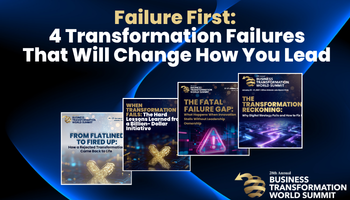
Transformation doesn't fail quietly. It fails in missed targets, stalled programs, frustrated teams, and strategies that looked perfect on paper but didn't survive reality – and yet, most leaders are still only hearing the success stories.
The Business Transformation World Summit's Failure Case Study Bundle brings together four candid, real-world transformation failures from experienced senior leaders who have been in the room, made the decisions, and seen what happens when things don't go to plan.
No polish. No hindsight bias. Just honest insight into what went wrong, and what they would do differently:
Download the bundle now and learn the valuable lessons most leaders only discover too late – and so you don't make the same mistakes they did.
Download Now