
Culture in process excellence: The advantage you can’t reverse engineer
Reverse engineering something as intangible as culture is almost impossible
Add bookmarkListen to this content
Audio conversion provided by OpenAI

When we talk about process excellence, the issue of culture often comes up. Many business books imply that leaders should copy the culture of certain companies. However, the fact that culture is intangible and can’t be copied is what makes it so powerful in the first place.
Culture is not only reflected in behaviors and practices. It is also the set of values shared by employees. Although culture doesn’t appear on an accounting statement, leaders still regard cultural values as an intangible asset. Talent is important, but at times, culture fit can be the deciding factor for a high-performing team.
Nobody knows precisely how someone identifies with their values. When people list their values, it is done intuitively. That list of phrases and words that represent a value, or values, is their best attempt at representing it. This is why reverse engineering something as intangible as culture is almost impossible.
Join the PEX Network community

Don't miss any news, updates or insider tips from PEX Network by getting them delivered to your inbox. Sign up to our newsletter and join our community of experts.
Learn MoreCulture goes beyond behavior
When departments try to transform culture, what typically happens is that they try to engineer behaviors they believe will cause culture. They mistakenly treat culture as the sum of behaviors. A plan might include a training calendar, a roadmap, and their own version of agile. The expectation is that replicating the stereotypical behaviors of a high-performing tech company will result in the desired culture, whatever it may be.
However, this attempt to plan culture might as well list random behaviors. These events don’t tell us anything about one of the biggest drivers of culture: shared values. There is no telling whether these activities reinforce poor values or whether those values are even relevant.
Leaders must go beyond the superficial idea of linking behavior to culture. Suppose for a moment that you could mimic human behavior perfectly. If a manufacturer from Stuttgart, Germany, copied every behavior of its sister manufacturer from Michigan, the original culture would not follow. Two employees can perform the same behavior and still hold vastly different assumptions. Since leaders do not know precisely what those assumptions are, they can only encourage their teams to reflect and explore whether the culture aligns with them.
In the end, they develop a personal understanding of their own values, because culture is personal, it becomes increasingly hard for others to copy. We can observe every high-performing company and copy their ‘ways of doing things,’ but culture goes beyond observable behaviors.
Register for All Access: Future of BPM 2026!
The German and Japanese example
Years ago, I had the chance to observe how companies across Eastern and Western cultures operated. They ranged from German manufacturers to French restaurants and Japanese electronics firms. These companies weren’t obsessed with terms like innovation or high performance, yet their innovations continue to inspire the world. More surprisingly, they did not treat innovation as a separate conversation.
In the first example, German manufacturing can be regarded as a cultural pursuit. The decision to pursue premium cars (i.e. Mercedes-Benz, BMW, and Audi) reflects a cultural preference rather than a purely economic one. Graduates of German trade schools are celebrated for mastering technical excellence. This mastery is inseparable from their culture. Across Europe, technical excellence is a cultural value. Artisans, engineers, and even chefs are rewarded for skill and precision, not just outcomes. They hold themselves accountable to higher performance, even when that means delivering precision products.
Let’s now turn to culture in the Japanese context. Like many Asian countries a century ago, Japan was largely an agricultural society. The transformation from an agricultural to an industrial society formed part of Japan’s curiosity for technical excellence. It was only after learning Western techniques that companies like Toyota developed their philosophy on process management. Toyota began with sewing machines before shifting toward cars and other machinery.
Japanese engineers had little experience in auto manufacturing. Kiichiro Toyoda, the founder of Toyota, travelled to Europe and the US in 1929 to learn about automotive engine manufacturing. Upon returning to Japan, the Toyota engineering team still struggled due to limited hands-on experience. They needed to study the inner components of a vehicle, so they purchased a Rolls-Royce and dismantled it for examination. This led Toyota to introduce an impressive line of prototypes, shaping its philosophy in the process. The value placed on process excellence was not something they initially set out to pursue, but rather something gained through the journey.
Despite Japan’s commitment to engineering, the one thing they chose not to engineer was culture. Culture was viewed as a way of life. It was, and still is, something intertwined with their philosophy. Some Japanese executives may be reluctant to claim that Toyota’s processes were an Asian invention. If asked, many would say that the techniques that made Toyota famous originated in the US. At the time, Japanese leaders adopted ideas from Edward Deming, a pioneer in quality management. They worked with Deming’s techniques until a culture of their own emerged from the process.
German and Japanese companies are well known for engineering. However, they do not take this same engineering approach to culture. Culture is more than the sum of its behaviors. It is superficial to ‘copy’ the behaviors of one company and ‘paste’ them onto another while hoping for the desired culture. What matters is developing a culture that reflects its own context. The values driving the behavior of a group are intangible. Observable behaviors can only tell us so much. To uncover the values underlying culture requires constant questioning. It requires a curious, yet disciplined, mind.
Read: 10 Kaizen mantras for process excellence!
Culture is difficult. That’s a good thing
I will end this article with a bold statement: culture is meant to be difficult. It is not meant to be easily copied and pasted like an Excel formula. This is precisely why culture can become an advantage.
Culture is too complex for financial ratios to fully capture, too impractical for engineers to model, and too fuzzy for mathematicians to quantify. Although culture has not been the main focus of science, it answers a question that doesn’t require one: “what makes my team unique and great?”
Tracking performance ratios may be useful, but they are hardly the characteristics that make a team stand out in an industry already full of high performers.
The Business Transformation World Summit's Failure Case Study Bundle
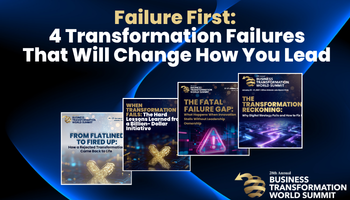
Transformation doesn't fail quietly. It fails in missed targets, stalled programs, frustrated teams, and strategies that looked perfect on paper but didn't survive reality – and yet, most leaders are still only hearing the success stories.
The Business Transformation World Summit's Failure Case Study Bundle brings together four candid, real-world transformation failures from experienced senior leaders who have been in the room, made the decisions, and seen what happens when things don't go to plan.
No polish. No hindsight bias. Just honest insight into what went wrong, and what they would do differently:
Download the bundle now and learn the valuable lessons most leaders only discover too late – and so you don't make the same mistakes they did.
Download Now