
Rockwell Automation & Eplan launch digital twin-driven electrical simulation integration
The integration connects Eplan’s schematic design tools with Emulate3D™ digital twin software from Rockwell Automation
Add bookmarkListen to this content
Audio conversion provided by OpenAI

Rockwell Automation and Eplan unveiled a new digital twin-driven electrical simulation integration at SPS 2025 in Nuremberg, Germany. It is designed to simplify electrical design and simulation.
The integration connects Eplan’s schematic design tools with Emulate3D™ digital twin software from Rockwell Automation, allowing engineers to virtually model, test, and optimize systems such as industrial robots, control panels, and automated conveyors before building any hardware.
This streamlines workflows, reduces engineering time (especially during the creation of the simulation model), and enhances accuracy, according to the announcement.
Digital twin tools are transforming the way businesses manage operations, optimize efficiency, and improve decision-making. By creating real-time virtual replicas of physical assets, processes or systems, organizations gain insights into performance, predictive maintenance, and overall operational health.
Join the PEX Network community

Don't miss any news, updates or insider tips from PEX Network by getting them delivered to your inbox. Sign up to our newsletter and join our community of experts.
Learn MoreRockwell Automation & Eplan launch digital twin integration
The Rockwell Automation-Eplan integration empowers engineers to simulate and validate electrical logic with speed and precision, bridging the gap between design and execution, said Gunther Saelzer, director software and control, north region at Rockwell Automation.
“By combining schematic design with dynamic simulation, teams minimize the design time for virtual commissioning and bring digital twin capabilities into everyday engineering.”
By importing Eplan schematics into Emulate3D, companies can simulate and validate production-line control systems in a virtual environment before committing to physical builds, reducing risk, improving accuracy, and accelerating development, stated a press release.
Engineers first use the Eplan Platform to design wiring diagrams and control panels with standardized components, then employ Emulate3D to test and verify these electrical systems early in the development cycle. Connecting control-cabinet layouts to digital-twin models further strengthens visibility and cross-team collaboration.
“Together with Rockwell Automation, we’re enabling a smarter, more connected engineering process,” commented Simon Budde, head of partner management at Eplan. “This new integration reduces engineering times from days to hours, delivering enormous value to manufacturers and machine builders by unlocking new levels of efficiency in control system design.”
Register for All Access: AI in PEX 2026!
Digital twins are driving business transformation
Digital twin technology can be a powerful enterprise-wide tool for organizations wanting to achieve business transformation. Several leading organizations are adopting digital twin tools to create new opportunities.
BMW Group is transforming global manufacturing operations with advanced digital twin technology. The world’s leading manufacturer of premium cars and motorcycles is scaling its Virtual Factory, with production planners continuously expanding applications in the digital twins of over 30 production sites to accelerate production planning worldwide.
H&M recently announced it would use artificial intelligence (AI) to create digital twins of fashion models. The retailer said it will use 30 AI-created models in some social media posts and marketing in the place of humans – if given permission to do so by their human counterparts.
Birmingham City University (BCU) has developed a pioneering digital twin to track air pollution. It is designed to help families in Walsall monitor and improve indoor air quality, making a life-changing difference for children living with asthma.
The Business Transformation World Summit's Failure Case Study Bundle
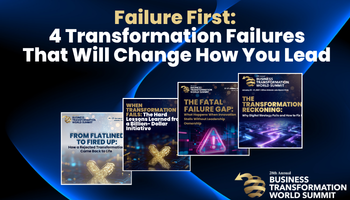
Transformation doesn't fail quietly. It fails in missed targets, stalled programs, frustrated teams, and strategies that looked perfect on paper but didn't survive reality – and yet, most leaders are still only hearing the success stories.
The Business Transformation World Summit's Failure Case Study Bundle brings together four candid, real-world transformation failures from experienced senior leaders who have been in the room, made the decisions, and seen what happens when things don't go to plan.
No polish. No hindsight bias. Just honest insight into what went wrong, and what they would do differently:
Download the bundle now and learn the valuable lessons most leaders only discover too late – and so you don't make the same mistakes they did.
Download Now