New AI creates “process mindlessness”
New forms of AI are generating “process mindlessness” – the application of AI without considering the overall business process
Add bookmarkListen to this content
Audio conversion provided by OpenAI

New forms of artificial intelligence (AI) are generating “process mindlessness” – the application of AI without considering the overall business process. That’s according to a Business & Information Systems Engineering (BISE) journal article.
The editorial, authored by leading process experts including Wil van der Aalst, examines three problematic effects of applying AI that degrade the wider process, rather than improving it.
It also outlines the effects of process mindlessness across various domains and sets out recommendations for addressing the issue to enhance the effectiveness of AI adoption.
Join the PEX Network community

Don't miss any news, updates or insider tips from PEX Network by getting them delivered to your inbox. Sign up to our newsletter and join our community of experts.
Learn MoreThe pros and cons of emerging AI
“The uptake of AI is amazing,” the editorial read. “Notably, recent developments in generative AI have enabled the effortless processing of text and images, the automation of simple tasks using agents, the automatic summarization of meetings, and the creation of new content. AI can accelerate operational and development processes, making them faster and more cost-effective.”
However, emerging AI also presents a range of significant and intricate problems, they added. These span technical, ethical, social, and geopolitical dimensions, posing new challenges for information systems engineering.
“AI systems can inherit and amplify biases present in training data, leading to unfair outcomes. AI can generate highly convincing fake content (deepfakes, fake news, etc.). AI relies on massive datasets, often collected without full consent, and enables authoritarian surveillance. Last, but not least, advanced AI capabilities are primarily controlled by a few big tech companies and wealthy countries, leading to new forms of inequality.”
Register for All Access: AI in PEX 2026!
3 ways AI creates process mindlessness
The vast growth and adoption of AI can contribute to process mindlessness in three key ways, according to the article. These are bloating, blurring, and blasting effects.
1. Bloating
Generative AI makes it easy to produce large volumes of polished text, but this abundance often lacks meaningful diversity, creating “text overload” and stress. Meetings and brief hints can now yield long reports, prompting recipients to use AI again just to summarize them. This cycle, one side inflating text and the other compressing it, resembles applying a function and then its inverse to recover the original intent. In practice, this process is often wasteful, as AI-driven text bloat can overwhelm participants and consume unnecessary resources.
2. Blurring
Organizations hold rich structured data alongside unstructured content like emails and notes. Decisions based on this data are usually structured and precise. Generative AI tempts users to convert structured data into text and then generate new text (e.g. recommendations) from it, but this translation “fuzzifies” clear information. As AI outputs are stochastic rather than rule-based, this process blurs reliable data and can ultimately undermine decision quality.
3. Blasting
AI systems scale with virtually no cost, delay, or capacity limits, eliminating the natural constraints imposed by physical processes and human labor. While this makes mass communication and action effortless, it also shifts the burden to recipients, who can be overwhelmed by floods of AI-generated messages or tasks. Traditional limits like postage costs, delivery time, or human workload functioned as stabilizing features that kept processes manageable. By removing these boundaries, AI can create overload and disrupt the balance that such constraints once maintained.
“It is essential to note that these problems pertain to situations where AI is functioning as intended, yet contributing to the degradation of overall processes,” the authors wrote. “The threshold for using AI is low, and tasks can be accomplished with limited effort.” Therefore, it is important to adopt a process perspective that considers overall goals and the risk of sub-optimization that can result from focusing on a single task.
Tackling AI-generated process mindlessness
The rise of generative AI and the resulting information overload can be understood as a rise in entropy within organizational and societal systems, the article indicated. There are three obvious recommendations that can turn that tide:
First, communication should carry some cost to discourage the effortless generation and distribution of excessive text enabled by digitalization and generative AI. Although information overload has long been recognized, past proposals to add friction like electronic stamps or micropayments have failed. Given AI’s impact, revisiting such ideas is worthwhile. Organizations could impose quotas and reward concise, accurate, and actionable communication to reduce overload.
Second, prioritize structured data and proper automation rather than converting structured information into text for AI to process. Using generative AI in this way increases entropy because translating clear data into unstructured text destroys known relationships and introduces randomness. If a chatbot can perform a task, it should instead be automated directly using structured processes.
Third, AI (especially generative AI) should be used only after applying first-principles and end-to-end process thinking. Before automating a task, ask how the AI output affects related tasks, the people involved, and the overall process. Local improvements may harm the larger workflow. Thoughtful process analysis is needed to prevent mindless or counterproductive use of AI.
The Business Transformation World Summit's Failure Case Study Bundle
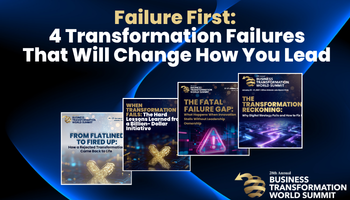
Transformation doesn't fail quietly. It fails in missed targets, stalled programs, frustrated teams, and strategies that looked perfect on paper but didn't survive reality – and yet, most leaders are still only hearing the success stories.
The Business Transformation World Summit's Failure Case Study Bundle brings together four candid, real-world transformation failures from experienced senior leaders who have been in the room, made the decisions, and seen what happens when things don't go to plan.
No polish. No hindsight bias. Just honest insight into what went wrong, and what they would do differently:
Download the bundle now and learn the valuable lessons most leaders only discover too late – and so you don't make the same mistakes they did.
Download Now