4 common process mapping mistakes (and how to avoid them)
Four common ways process improvement professionals go wrong with process mapping
Add bookmark
Process mapping provides a structural analysis approach and a capability of delivering systematic outputs. But the effectiveness of process mapping is affected by how it is selected as the method of analysis, how it is planned and executed, says contributor Shu-Wing Pang. Here are 4 common ways process improvement professionals go wrong with process mapping.
Process mapping is an analytical tool commonly applied by process improvement professionals. By capturing real-world operation and reflecting it through a set of processes, they can, firstly, visualize the inputs, interactions, deliverables and parties involved in an organization's operation and decision-making, and secondly, identify process inefficiencies, disjoints and improvement opportunities.
Join the PEX Network community

Don't miss any news, updates or insider tips from PEX Network by getting them delivered to your inbox. Sign up to our newsletter and join our community of experts.
Learn MoreThe effectiveness of process mapping, however, varies significantly based on the writer’s experience and observations. On one procurement process reengineering project, for example, process mapping was appropriately applied to summarize core processes and identify non-value-added activities to facilitate improvement; but on another project, the consultants involved failed to capture the true scale of the operational processes in the organization and the resultant improvement was unable to address the real underlying problems.
The following are four common problems that adversely affect the use of process mapping on identifying improvement opportunities. These problems are related to the appropriate use of the process mapping method, how process mapping is planned and executed. Below are some of the mistakes that most organizations do while using process mapping.
1. Apply process mapping to the wrong types of processes
Most organizations' business operations can be categorized into three types of processes: transformational processes, transactional processes and decision-making processes.
Transformational processes refer to the interactions where specific inputs are reshaped to outputs with changes in physical or virtual forms. Manufacturing (change in physical forms) and systems development (change in virtual forms) are typical examples of transformational processes.
Transactional processes refer to the interactions of different input parties where they accomplish to generate specific outcomes. Call center support and most sales activities are examples of transactional processes.
Decision-making processes refer to the interactions of different input parties where they accomplish to make decisions. The decisions made can be within a pre-defined range (e.g. approve or reject an application) specific or open-ended (e.g. what is the optimal market entry price level?). Pricing, market forecasting and inventory control are examples of decision-making processes.
Process mapping is more effective at identifying process improvement opportunities on transformational and transactional processes than decision-making processes, especially those involving high-level, open-ended decisions.
This is because, firstly, the outputs from such transformational and transactional processes tend to be more specific and objectively defined (e.g. specific products and service outputs) and secondly, process variations are more traceable.
By contrast, high-level, open-ended decision-making processes tend to be abstract and intangible. Also, the fact that such decision-making involves a lot of dynamic, unpredictable factors mean that it is the quality of individuals gathering, processing and analyzing the information which matters. Process mapping is seldom the most optimal method of identifying and visualizing improvement opportunities in these circumstances.
2. Being unclear about the focus of your process mapping
Preliminary analysis can point to areas where process inefficiencies or disjoints occur, but their underlying causes may reside outside the processes where these problems are diagnosed. For example, I was once involved in a hotel process improvement project where the problem of room service was addressed. The delivery process was mapped and analyzed and no major shortcoming was identified. But when it came to interviewing and Gemba assessment, it was found that the problem was not caused by room service delivery but because staff lifts were frequently occupied by housekeeping team for transporting laundry.
This case showed that cause of process inefficiency can be caused outside the process being addressed. Additionally, the effectiveness of process mapping will diminish if the process improvement team is ambiguous on determining whether it is the core or secondary processes (i.e. variations from core processes to cater for exceptional and unique scenarios, transitional (interim) processes or supplementary processes) on which they should focus on.
3. Trying to create the "perfect" process maps (and forgetting why you’re process mapping in the first place)
Improvement professionals and their business-side counterparts sometimes bury themselves in process mapping analysis and forget the goal of improvement (i.e. improving the business) and instead focus on building ‘perfect’ process maps. For instance, when business communities visualize how their processes are reflected on process maps, they are tempted to describe and explain it in a way which will make the processes ‘join together and make logical sense’.
4. Weakness on cross-party responsibilities
As a format of presentation, process maps are never ideal when it comes to showing multiple responsibilities among different parties, especially when one of them plays a leadership role. For example, on a swim-lane diagram, a cross-team activity is usually indicated by a task which extends across several swim-lanes to the responsible parties; it, however, is difficult to display a leading party in a clear way graphically. Less experienced process analysts and improvement professionals may overlook the leadership dimension on the analysis.
Developing better practices for process mapping
The effectiveness of process mapping as a continuous improvement tool diminishes when process improvement practitioners are not aware of the problems mentioned above. The following guidelines are recommended to address these problems.
Establish clear continuous improvement objectives
What are the objectives of the improvement initiative? Is the goal of improvement to resolve existing operational problems (e.g. error reduction) or capture emerging market opportunities? Is process standardization the objective of the improvement initiative? Is it primarily driven by technological change? Is it a major restructuring effort or an incremental change? These are key questions that help continuous improvement practitioners clarify the goals and objectives of the improvement efforts and therefore identify suitable methods of analysis.
For example, in an IT-related process improvement exercise, for example, process mapping can be highly valuable to outlining existing processes, identifying problems and areas where technological changes can facilitate the improvement. Process mapping also produces concrete deliverables which become an input to system requirements.
However, for an organizational transformation that involves drastic changes on organizational structures, job roles and responsibilities, and staff’s knowledge and skill-sets, process mapping may not be the best method to be used at least at the beginning (vision planning may be better suited in this case). It is essential that continuous improvement professionals have the capability to clarify improvement goals, objectives and requirements at the beginning, understand the pros, cons and applicability of different improvement methodologies, and apply the right methods in the right situation.
Use process mapping where it's most appropriate
Process improvement practitioners should proactively assess the nature of processes being addressed and decide if process mapping can yield most benefits in identifying improvement opportunities and assessing the scope of change. They should also determine if process mapping can be as a standalone tool or in conjunction with other analysis methods such as document analysis and Gemba.
It has been explained before that process mapping tends to be more effective on transformational and transactional processes. Performing process mapping on a high-level and open-ended decision-making process may not yield the best results in identifying improvement opportunities.
Therefore, when attempting to analyze such processes for driving change, process improvement professionals should apply such as decision-making schemas and documentation analysis in addition to process mapping in order to look at the quality and congruence of decisions made.
Make use of process architecture (if it exists)
In organizations where process maturity is relatively high and process architecture is established, the process architecture is a valuable and structural input to process improvement professionals.
Process architecture, which includes process map structures, process management guidelines, standards and methodologies, is a comprehensive visual representation (in graphical, diagrammatic or other forms) of an organization’s key processes and interactions. It provides an integrated Organization-Process-System-Information visibility and is used to assess how the organization’s structure and process can support its strategy.
Assess the impact of organizational structures
When conducting process mapping, continuous improvement professionals should pay attention to macro-level features such as organizational structures and headcounts because these issues may be hidden within formal processes and it also generates new ideas on what to improve.
Identify multiple responsibilities for tasks
To tackle the limitation that process maps are less effective in showing cross-party responsibilities, especially when some of them play a leadership role, process analysis practitioners should pay particular attention when analyzing relevant processes or activities to ensure that such multiple responsibilities and the roles of each party are clarified.
Documentation analysis, for instance, is a good, complimentary analysis method in this aspect. Such clarification on multiple responsibilities and ownership may also yield insights on potential improvement opportunities which can be explored further (if no clear ownership can be identified or responsibilities among different parties are blurred, for example).
Choose the right process improvement method
Applying suitable analytical methods to study current processes and spot opportunities for improvement is key to the success of such initiatives. Process mapping, with its structural analysis approach and capability of delivering systematic outputs, is a widely-used methodology.
However, like other continuous improvement methods, the effectiveness of process mapping is affected by how it is selected planned and carried out. Whether or not process mapping is actually an appropriate method of continuous improvement in a particular situation is also a determining factor.
Therefore, continuous improvement practitioners should be clear about the strengths and limitations of different process improvement methodologies, and their applicability in different improvement initiatives. The above discussion points out several areas where the practitioners should pay attention to in order to maximize the benefits of improvement through process mapping.
The Business Transformation World Summit's Failure Case Study Bundle
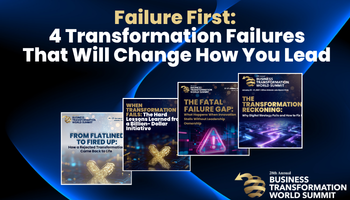
Transformation doesn't fail quietly. It fails in missed targets, stalled programs, frustrated teams, and strategies that looked perfect on paper but didn't survive reality – and yet, most leaders are still only hearing the success stories.
The Business Transformation World Summit's Failure Case Study Bundle brings together four candid, real-world transformation failures from experienced senior leaders who have been in the room, made the decisions, and seen what happens when things don't go to plan.
No polish. No hindsight bias. Just honest insight into what went wrong, and what they would do differently:
Download the bundle now and learn the valuable lessons most leaders only discover too late – and so you don't make the same mistakes they did.
Download Now